Table of Contents
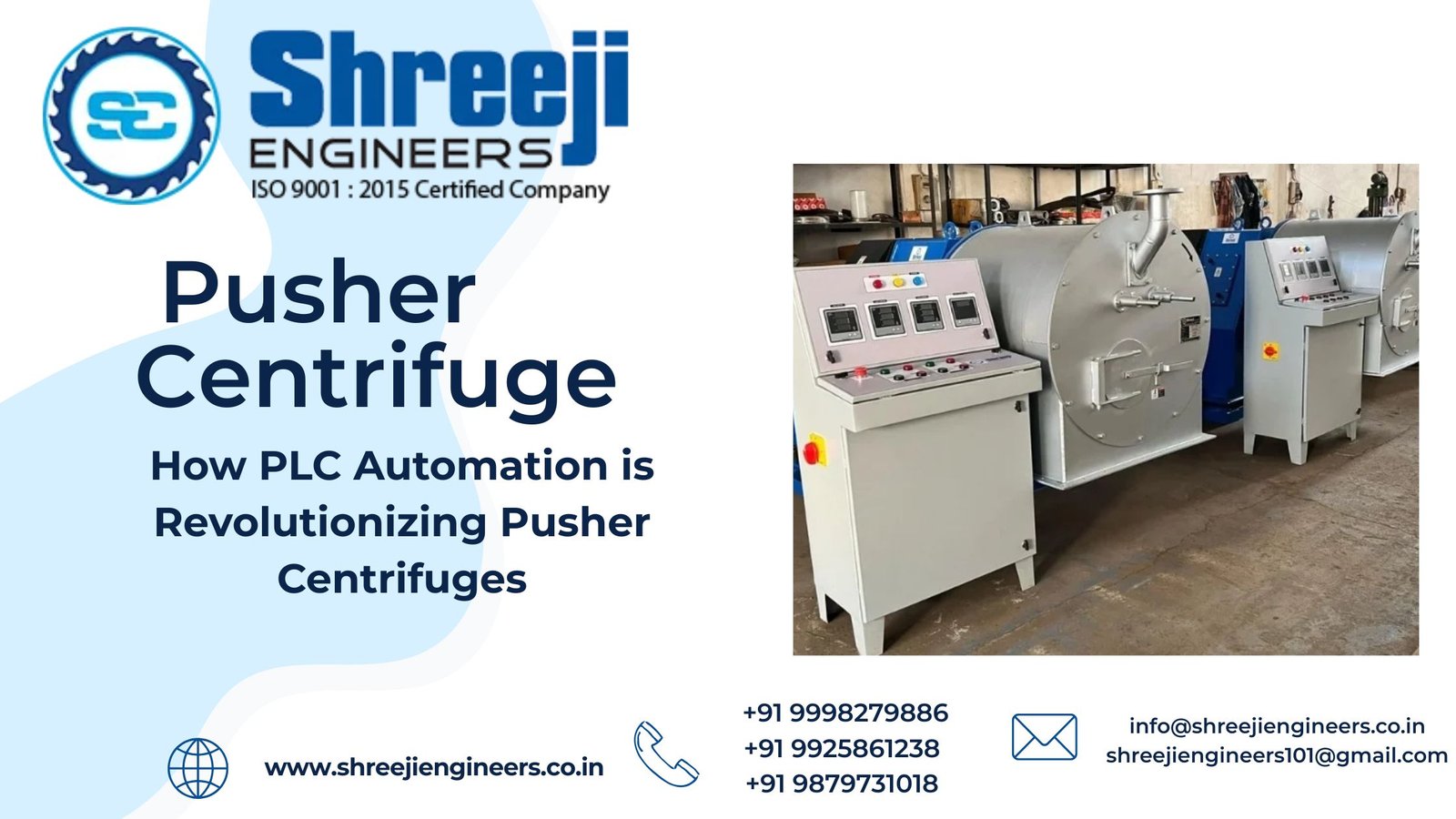
In the past, operating a centrifuge was a hands-on task that relied heavily on the experience of the machine operator. Today, the industry is shifting toward “intelligent” manufacturing, where PLC (Programmable Logic Controller) systems handle the precision work of monitoring, adjusting, and safeguarding your equipment in real-time.
At Shreeji Engineers, we are integrating advanced automation into our pusher centrifuges to help plants achieve higher consistency and lower operational risk. Here is how PLC systems are changing the game.
1. Real-Time Performance Monitoring
Manual monitoring is reactive—you only notice a problem when the machine stops or starts making noise. A PLC-integrated system is proactive. It monitors critical metrics like:
-
Hydraulic Pressure: Detecting internal leaks or pump fatigue before they cause a stoppage.
-
Cycle Timing: Ensuring every push-stroke is perfectly timed to maintain the ideal cake thickness.
-
Vibration Thresholds: Automatically slowing down or shutting down the machine if vibration exceeds safe limits, preventing catastrophic structural damage.
2. Dynamic Feed Optimization
One of the biggest challenges in solid-liquid separation is feed inconsistency. A PLC system can be linked to your upstream feed pump. If the system detects a drop in feed density, it can automatically adjust the pusher frequency or basket speed to maintain a consistent moisture level in the cake.
-
The Result: A uniform final product that requires less energy to dry and meets stricter quality standards.
3. Advanced Safety Interlocks
Safety is the highest priority in any manufacturing facility. PLC systems allow for a “multi-layered” safety approach. If a safety guard is opened, or if a bearing temperature hits a critical limit, the PLC triggers an instant, controlled emergency stop. This prevents human injury and protects the machine’s most expensive components from secondary damage.
4. Data Logging and Predictive Maintenance
Modern chemical and processing plants are becoming “data-driven.” PLC systems record historical operating data, allowing your engineering team to spot trends.
-
Predictive Maintenance: If the data shows that your hydraulic motor is drawing slightly more current than it did three months ago, you can schedule an inspection during a planned shutdown. You aren’t just reacting to failures; you are preventing them.
5. Seamless Integration with Plant SCADA
For larger facilities, integrating your Pusher Centrifuge into the plant-wide SCADA (Supervisory Control and Data Acquisition) system is a game-changer. It allows your central control room to monitor multiple machines simultaneously, reducing the need for personnel to be physically present at every unit on the floor.
Manufacturer’s Insight: Automation is not just about replacing labor—it’s about amplifying the capabilities of your team. By letting the PLC handle the repetitive task of monitoring variables, your operators can focus on higher-level tasks like optimizing process parameters and quality control.
Export Countries
We proudly manufacture and export to customers across domestic and international markets. Our export markets include:
-
Turkey
-
Bangladesh
-
Philippines
-
Thailand
-
Sri Lanka
-
Tanzania
-
Uganda
-
Indonesia
-
Egypt
-
Iran
-
Ghana
We ensure secure packaging, timely delivery, and reliable export documentation for international customers.
Conclusion
The integration of PLC automation is the next frontier for industrial separation. By moving to an automated control setup, you aren’t just buying a machine; you are investing in a smarter, safer, and more reliable production line.
Are you looking to modernize your plant with automated separation technology?
Contact the engineering team at Shreeji Engineers today. We specialize in custom-configuring PLC systems to suit your specific industrial application, ensuring your centrifuge works harder, lasts longer, and provides the data you need to stay ahead.

 Users Today : 9
 Users This Month : 170
 Total Users : 1078