Table of Contents
Choosing the right solid-liquid separation equipment is one of the most significant capital expenditure (CAPEX) decisions a plant manager will face. Two of the most common options are Continuous Pusher Centrifuges and Batch Centrifuges.
While both are capable of separating solids from liquids, they operate on completely different principles. At Shreeji Engineers, we often help clients evaluate which machine is better suited for their specific throughput and product quality needs. Here is how they stack up.
1. Operational Throughput
-
Batch Centrifuges: As the name implies, these work in cycles. The machine must accelerate, load, spin, unload, and stop before the next cycle begins. This creates a “pulsed” output, which can lead to bottlenecks in your drying or bagging lines.
-
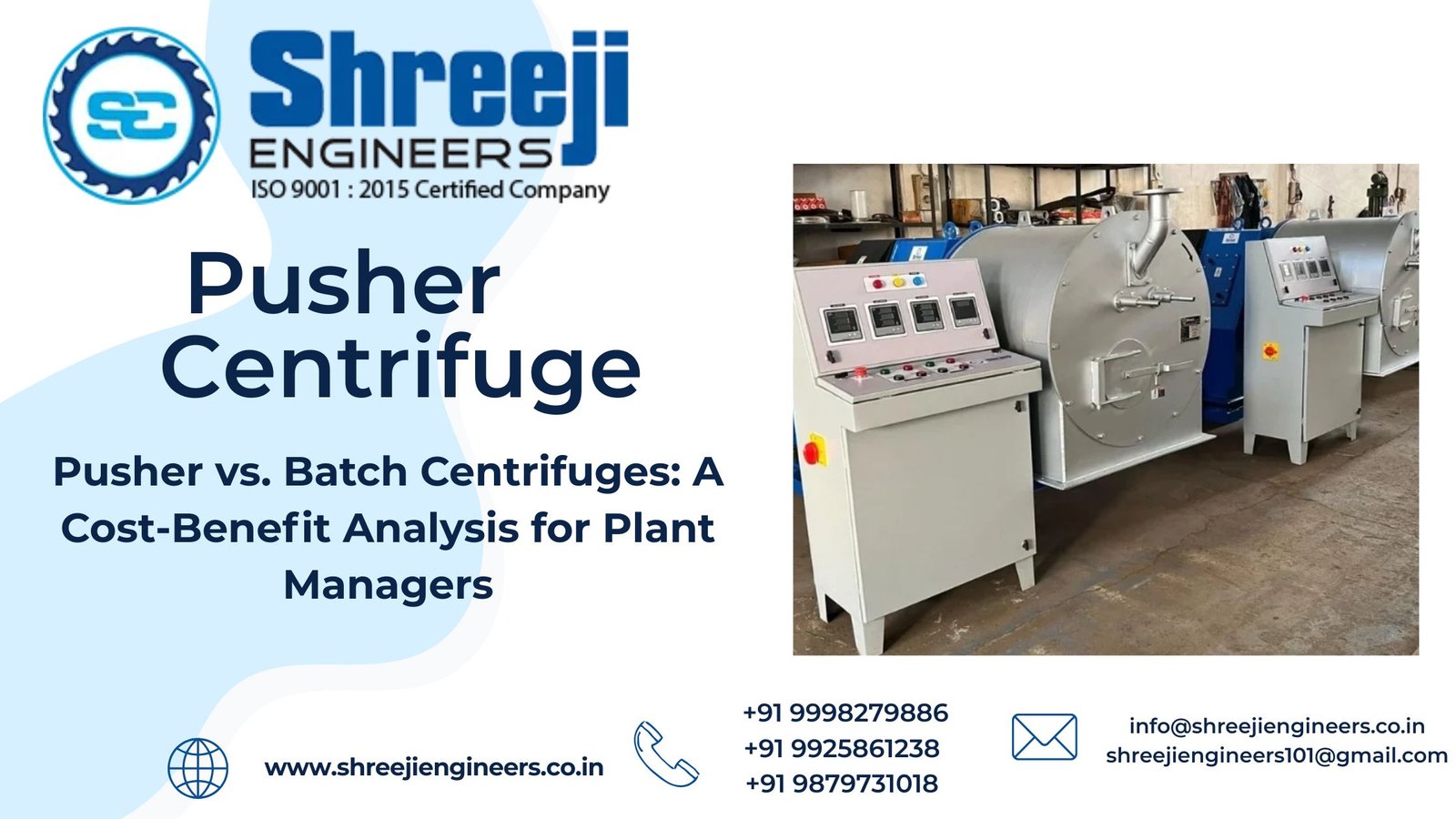
Pusher Centrifuges: These provide a continuous stream. Because the machine is constantly separating and discharging material, it can handle significantly higher volumes per hour. If your goal is high-capacity, steady-state production, the pusher centrifuge is the clear winner.
2. Purity and Washing Efficiency
-
Batch Centrifuges: Because the machine stops and starts, washing can be inconsistent. The cake may settle unevenly, leading to “channeling,” where the wash liquid flows through cracks in the cake rather than cleaning the entire volume of solids.
-
Pusher Centrifuges: The constant movement of the cake across the filter screen allows for precise, uniform washing. This typically results in higher product purity and more consistent chemical quality, making them the preferred choice for high-purity chemical and salt processing.
3. Wear and Maintenance
-
Batch Centrifuges: The frequent stop-start cycles put extreme stress on motors, clutches, and brakes. These components are frequent failure points that require ongoing maintenance.
-
Pusher Centrifuges: While they have more internal moving parts (like the hydraulic pusher mechanism), they do not suffer from the mechanical fatigue caused by constant acceleration and deceleration. If the hydraulic system is well-maintained, these machines offer superior long-term reliability for 24/7 operations.
4. Total Cost of Ownership (TCO)
Batch Centrifuges: Often have a lower upfront price tag. This makes them attractive for small-scale applications or plants where production is intermittent.
Pusher Centrifuges: Have a higher initial investment but a lower Total Cost of Ownership for large-scale operations. When you factor in labor savings (due to automation), energy efficiency, and higher product yield, the pusher centrifuge often pays for itself through increased profitability within the first few years of operation.
Manufacturer’s Insight: The “right” choice depends entirely on your process. If you are processing thousands of tons of material per day, a Batch Centrifuge will almost certainly be an operational bottleneck. However, for specialty, low-volume chemical batching, a Batch unit might provide the flexibility you need
Comparison Summary Table
| Feature | Batch Centrifuge | Continuous Pusher Centrifuge |
| Throughput | Low/Intermittent | High/Continuous |
| Output Quality | Variable | Highly Consistent |
| Best For | Low-volume, small batching | Large-scale production lines |
| Automation | Basic | dvanced/PLC-Ready |
| Wear Profile | Mechanical stress (stops/starts) | Erosive wear (continuous contact) |
Conclusion
Still deciding which machine fits your plant’s future?
Contact the engineering team at Shreeji Engineers today. We can perform a capacity audit and help you calculate the ROI of moving to a continuous separation setup.

 Users Today : 9
 Users This Month : 170
 Total Users : 1078