Table of Contents
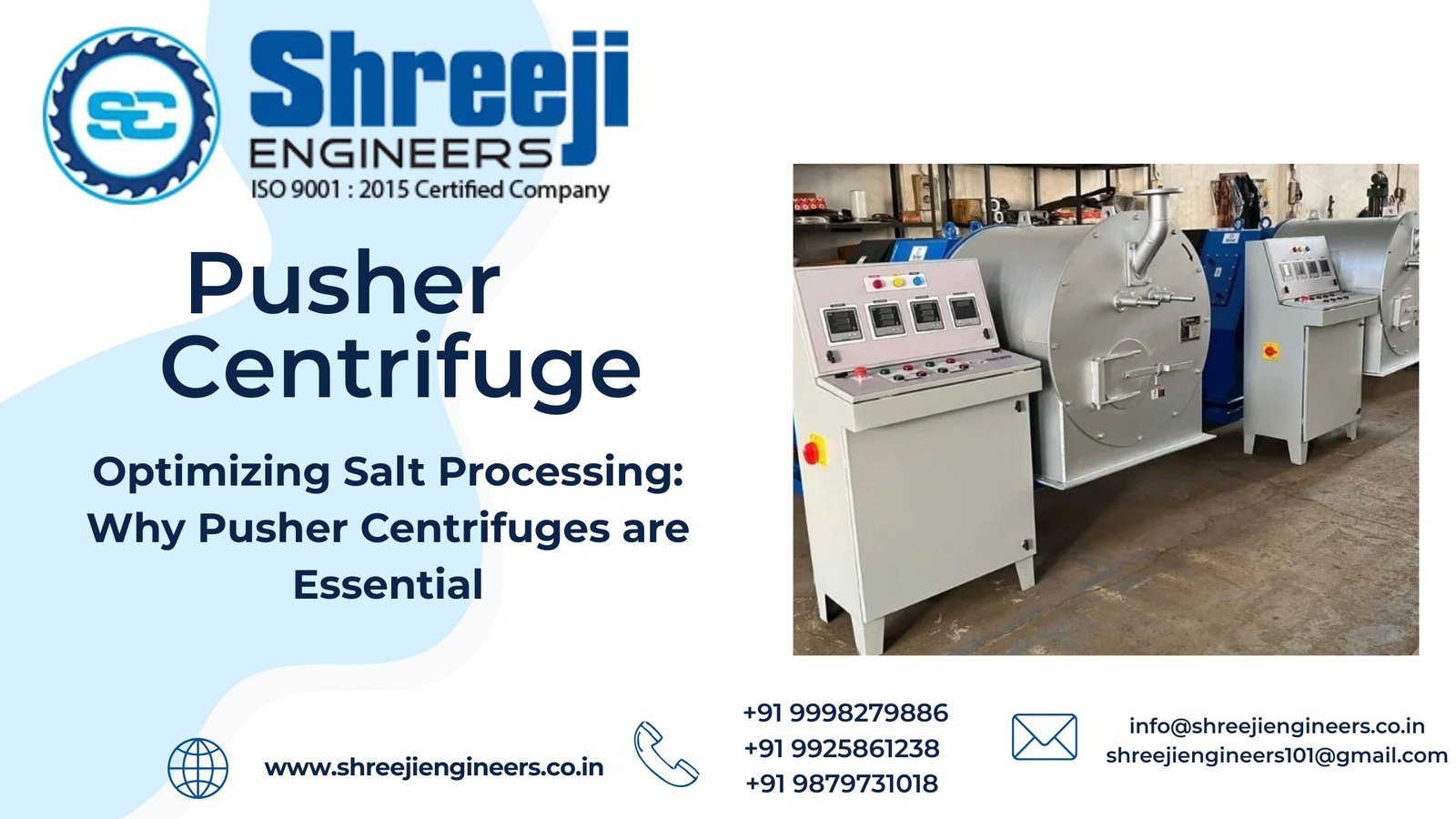
In industrial salt manufacturing, achieving low residual moisture and high crystal integrity is critical. Whether processing vacuum salt, sea salt, or refined rock salt, the pusher centrifuge for salt stands as the industry standard for continuous, high-capacity solid-liquid separation.
Engineered for heavy-duty performance, a reliable salt centrifuge ensures efficient dewatering, minimal crystal breakage, and continuous operation, making it an indispensable asset in modern salt processing plants.
How a Pusher Centrifuge Works in Salt Processing
The continuous salt centrifuge operates on a multi-stage centrifugal filtration principle designed to handle high solid throughputs seamlessly:
- Feeding & Slurry Distribution: The salt crystal slurry is fed continuously through the feed pipe into the rotating basket.
- Filtration & Dewatering: As the basket spins at high speeds, centrifugal force drives the mother liquor through the filter screen, while salt crystals are retained to form a solid cake.
- Pushing Action: A reciprocating pusher plate moves back and forth axially, incrementally advancing the salt cake toward the discharge end.
- Washing (Optional): If high-purity salt is required, wash liquid can be sprayed onto the cake during transit to remove residual impurities.
- Discharge: The dewatered salt crystals are continuously discharged into a collection hopper with minimal crystal degradation.
Key Advantages of Using a Pusher Centrifuge for Salt
- Low Residual Moisture: Advanced centrifugal dynamics ensure the final salt product achieves exceptionally low moisture content, reducing subsequent thermal drying energy costs.
- High Crystal Integrity: Gentle yet effective mechanical handling prevents excessive breakage of salt crystals, maintaining a uniform particle size distribution.
- Continuous Operation: Unlike batch centrifuges, the multi-stage pusher centrifuge runs continuously with automated control, maximizing plant productivity and minimizing downtime.
- Corrosion-Resistant Construction: Because saline environments are highly corrosive, contact parts are manufactured from high-grade materials such as SS316L, 2205 Duplex, or Titanium to guarantee long operational lifespans.
- Energy Efficient: High mechanical efficiency ensures optimized power consumption per ton of processed sodium chloride.
Technical Specifications & Operational Parameters
| Parameter | Typical Industrial Range |
| Capacity | Up to several tons per hour (depending on model size and feed concentration) |
| Basket Diameter | Custom-engineered to match plant throughput requirements |
| Material of Construction | Stainless Steel (SS304/SS316L), Duplex Steel, Titanium |
| Drive Type | Hydraulic or mechanical reciprocating pusher mechanism |
| Application | Vacuum salt, solar salt, industrial salt refining, sodium chloride dewatering |
Applications in the Salt Industry
A dedicated salt processing centrifuge is deployed across various stages of salt production:
- Vacuum Salt Plants: Rapid dewatering of slurries generated from multi-effect evaporation systems.
- Solar & Rock Salt Processing: Washing and drying harvested salt crystals to meet commercial or industrial purity standards.
- Chemical Grade Salt: Achieving stringent purity and dryness levels required for chlor-alkali and chemical manufacturing plants.
Why Choose Shreeji Engineers?
At Shreeji Engineers, we design and manufacture robust, high-performance industrial salt processing equipment tailored to your facility’s exact requirements. Our pusher centrifuges are engineered for durability, easy maintenance, and optimal energy efficiency, helping you reduce operational costs while maximizing output quality.
Conclusion
Salt processing is an unforgiving environment, but with the right continuous pusher centrifuge, it can be a highly efficient, high-purity operation. By selecting equipment designed for corrosion resistance and precise crystal handling, you can elevate your production standards and reduce your operational costs.
Are you operating a salt plant and looking to improve your crystal quality or throughput?
Contact the engineering team at Shreeji Engineers today. We have the technical experience to help you configure a pusher centrifuge that is built to stand up to the salt environment while delivering consistent, high-purity results.

 Users Today : 9
 Users This Month : 170
 Total Users : 1078