Table of Contents
In the mineral processing and mining industries, solid-liquid separation is a vital operational step. Whether dewatering coarse mineral crystals, chemical salts, or industrial ores, plant operators require equipment that delivers high throughput, reliable performance, and minimal moisture retention.
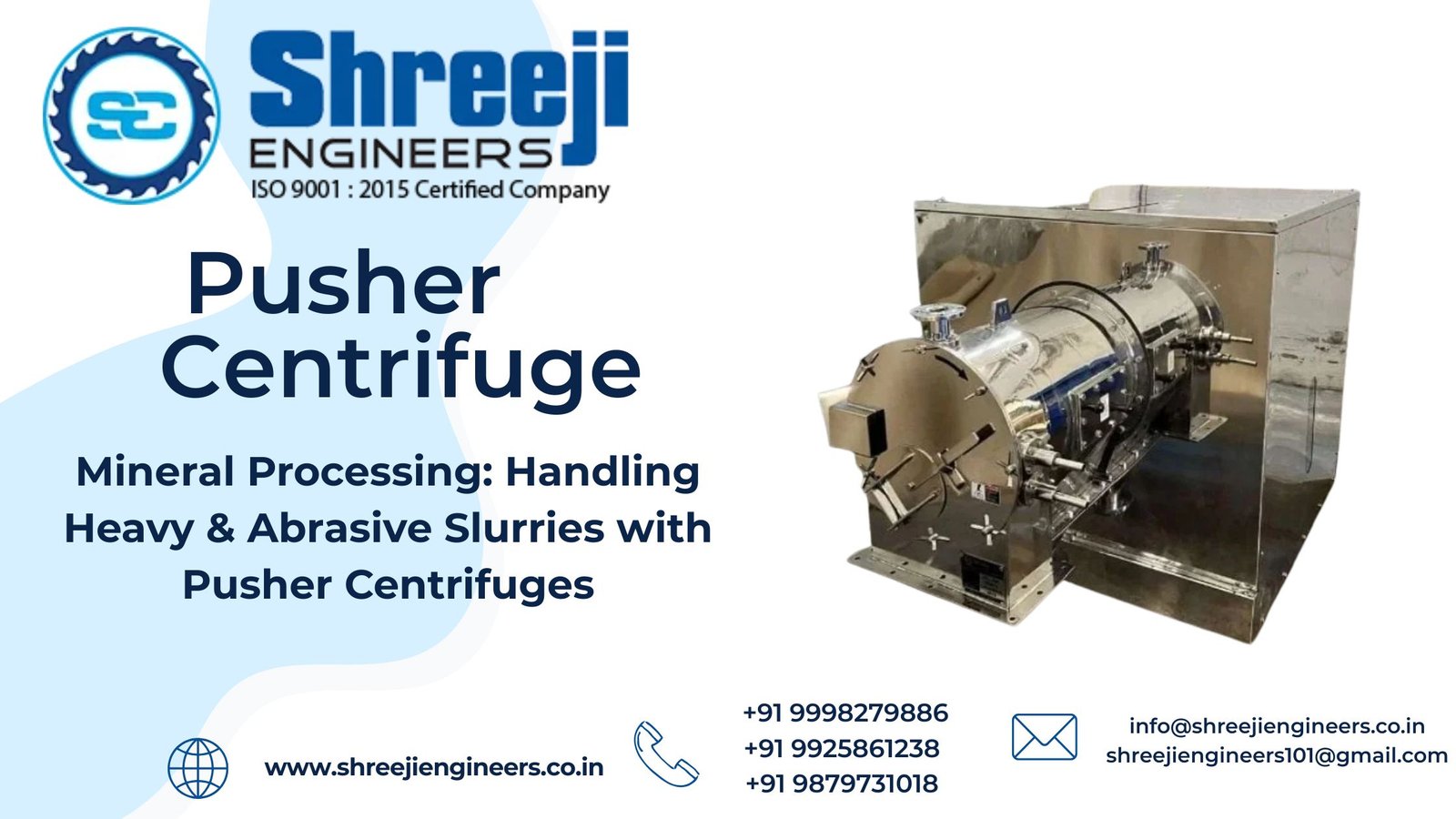
Among various centrifugal technologies, the pusher centrifuge for mineral processing has emerged as a premier solution for continuous, heavy-duty dewatering.
The Role of Solid-Liquid Separation in Mineral Slurries
Mining and mineral refinement often yield high-volume slurries containing valuable solid crystals mixed with mother liquor or process water. Effective separation is essential for:
- Reducing Thermal Drying Costs: Lower moisture content coming out of the centrifuge directly translates to reduced energy consumption in downstream rotary or fluid-bed dryers.
- Recovering Valuable Byproducts: Maximizing liquid recovery and crystal purity ensures high overall mineral yield.
- Streamlining Downstream Handling: Dry, free-flowing solids are significantly easier to transport, store, and package.
How a Pusher Centrifuge Operates in Mineral Applications
The mineral processing centrifuge relies on a continuous, multi-stage centrifugal filtration mechanism designed to handle abrasive and high-density slurries:
- Slurry Feed: The mineral suspension or crystal slurry is continuously introduced into the rotating basket via a feed pipe.
- Centrifugal Dewatering: As the basket spins at high speeds, centrifugal force presses the slurry against the filter screen. The liquid phase (mother liquor) passes through the screen, while the solid mineral particles form a uniform cake.
- Axial Pushing Action: A reciprocating pusher plate moves back and forth rhythmically, advancing the mineral cake step-by-step toward the discharge end of the basket.
- Washing (If Required): Wash liquid can be sprayed across the cake during transit to leach out soluble impurities or chemical residues.
- Continuous Discharge: The dewatered mineral crystals discharge continuously into a collection housing with minimal mechanical degradation.
Key Advantages of Using a Pusher Centrifuge for Minerals
- High Processing Capacity: Multi-stage pusher designs are built to handle massive throughput volumes, making them ideal for large-scale mining operations.
- Exceptional Dewatering Efficiency: Achieves low residual moisture in the discharged solid cake, minimizing subsequent energy and drying expenses.
- Handling Abrasive Materials: With proper metallurgy and wear-resistant screen designs, modern centrifuges withstand the abrasive nature of harsh mineral slurries.
- Continuous, Automated Operation: Unlike batch-type centrifuges, pusher centrifuges run continuously, reducing labor overhead and operational bottlenecks.
- Rugged Construction: Built using high-grade corrosion-resistant alloys (such as SS316L, 2205 Duplex, or specialized stainless steels) to endure aggressive chemical environments.
Typical Applications in the Mining & Mineral Sector
While versatile across chemical industries, the industrial pusher centrifuge is heavily relied upon in specific mineral processing sectors:
- Potash and Fertilizer Processing: Dewatering potassium chloride (KCl) and other salt-based mineral crystals.
- Sulfate & Phosphate Refining: Separating crystalline byproducts from pregnant leach solutions.
- Coal and Ore Processing: Specialized crystal and coarse mineral separation where sharp cut-offs and high recovery rates are required.
1. The Challenge: Extreme Abrasion
Minerals are often naturally abrasive. A standard centrifuge basket or feed pipe can be eroded to the point of failure in a matter of weeks if it isn’t specifically designed for the hardness of the material being processed.
-
The Solution: Our centrifuges are engineered with hardened wear liners and proprietary wear-resistant alloys. By reinforcing the “impact zones”—the areas where the slurry first hits the distribution cone or the screen—we ensure that the machine can withstand constant exposure to abrasive mineral particles.
2. Managing High-Density Slurries
Mineral slurries often have a very high solids-to-liquid ratio. Pushing this material requires significant mechanical force.
-
The Advantage: Our pusher mechanisms are designed with robust hydraulic systems that provide consistent, reliable force. This ensures that even the heaviest mineral cakes are moved smoothly through the basket without stalling or excessive power consumption.
3. High-Capacity Continuous Throughput
Mineral plants operate 24/7. When you are processing vast quantities of material, any downtime for cleaning or screen replacement represents a massive loss of potential revenue.
-
The Advantage: The continuous nature of the pusher centrifuge is ideal for mining applications. Because the solids are being constantly “pushed” out of the basket, there is no chance for solids to build up and plug the system, allowing for longer, uninterrupted production runs.
4. Reducing Particle Degradation
- The Advantage: Because our design relies on a gentle, reciprocating push motion rather than violent, high-impact discharge, your mineral product remains structurally intact. This preserves the particle size distribution, ensuring your final product meets your customer’s exact requirements.
Manufacturer’s Insight: When choosing a centrifuge for minerals, always ask the manufacturer about their wear-part replacement program. In heavy-duty mineral applications, wear is inevitable—the key to success is having a partner who can provide easy-to-install, wear-resistant replacement parts that get you back in production in hours, not days.
Conclusion
Mineral processing is a high-stakes, high-wear environment. You need equipment that is built to take a beating and keep running. By utilizing pusher centrifuges with reinforced wear zones and robust hydraulic systems, you can ensure your separation process remains efficient, even when dealing with the most abrasive materials.
Are you operating a mineral processing plant and looking for a more durable separation solution?
Contact the engineering team at Shreeji Engineers today. We have the technical expertise to analyze your slurry profile and recommend a configuration that maximizes your throughput while minimizing your wear-and-tear costs.

 Users Today : 9
 Users This Month : 170
 Total Users : 1078