Table of Contents
Automatic Pusher Centrifuge Manufacturer
In modern industrial processing, automation plays a crucial role in improving productivity, reducing manual intervention, and maintaining consistent product quality. An Automatic Pusher Centrifuge is a highly efficient continuous filtration machine designed to automate the solid-liquid separation process while ensuring high throughput and low operating costs.
Widely used across chemical, pharmaceutical, fertilizer, food, and mineral processing industries, this centrifuge combines advanced automation with reliable filtration performance to handle large production volumes with precision.
What is an Automatic Pusher Centrifuge?
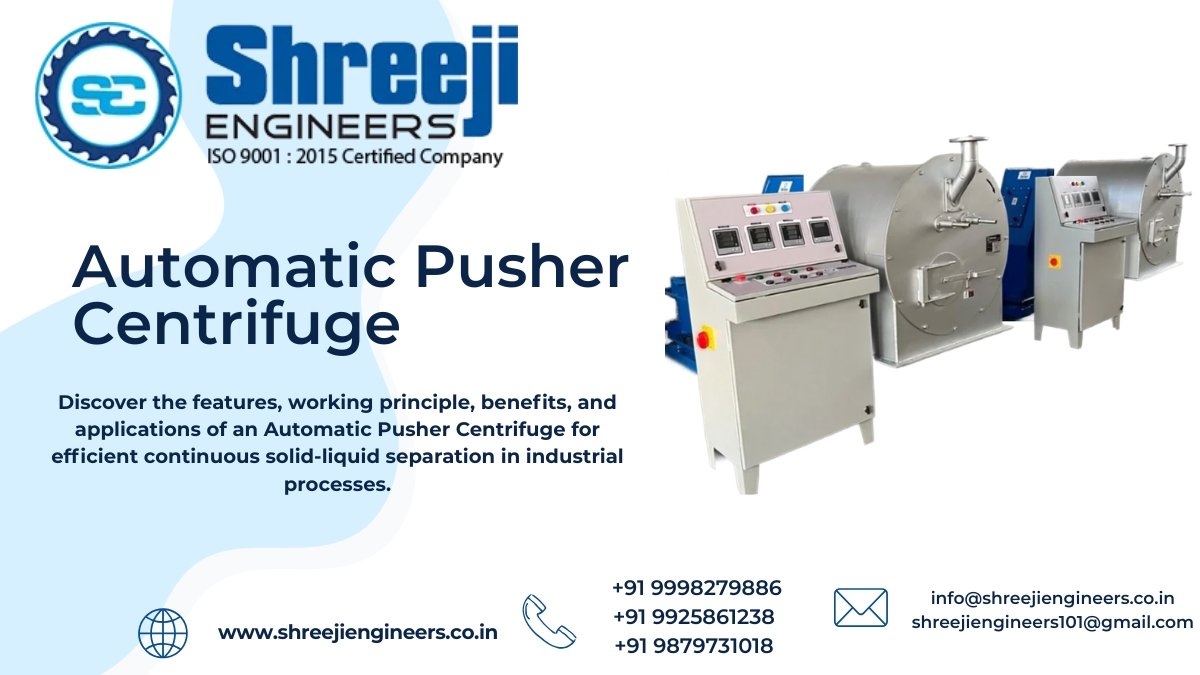
An Automatic Pusher Centrifuge is a continuous centrifuge equipped with an automated hydraulic or mechanical pusher mechanism that continuously separates solids from liquids without stopping production. Unlike conventional batch centrifuges, it automatically feeds the slurry, filters the liquid, washes the crystals (if required), removes excess moisture, and discharges the solids in a continuous cycle.
Its automated operation reduces human intervention while improving process efficiency, product consistency, and operational safety.
How Does an Automatic Pusher Centrifuge Work?
The working process of an Automatic Pusher Centrifuge includes several automated stages:
1. Automatic Slurry Feeding
The slurry is continuously supplied into the rotating basket through an automated feed system.
2. High-Speed Separation
The basket rotates at high speed, generating centrifugal force that separates liquid from solid particles.
3. Filtration Process
The liquid passes through the perforated basket and filter media while the solids remain inside.
4. Automatic Washing
If required, the machine sprays water or solvent over the solids to remove impurities.
5. Dewatering
Additional centrifugal force removes residual moisture from the product.
6. Continuous Solid Discharge
The automatic pusher mechanism continuously moves the filtered solids toward the discharge outlet without interrupting production.
Key Features of an Automatic Pusher Centrifuge
An Automatic Pusher Centrifuge offers several advanced features, including:
- Fully automatic operation
- Continuous solid-liquid separation
- High-speed filtration
- Low residual moisture
- Hydraulic or mechanical pusher system
- Efficient crystal washing
- Heavy-duty stainless steel construction
- Low vibration design
- Energy-efficient motor
- PLC-based control system
- Easy maintenance
- Long service life
Advantages of an Automatic Pusher Centrifuge
Continuous Production
Eliminates downtime associated with batch processing.
Reduced Manual Labor
Automation minimizes operator involvement.
High Processing Capacity
Handles large production volumes efficiently.
Excellent Moisture Reduction
Produces drier crystals with consistent quality.
Improved Product Recovery
Reduces material losses during separation.
Consistent Performance
Maintains stable operating conditions throughout production.
Lower Operating Costs
Optimized design reduces maintenance and energy consumption.
Enhanced Safety
Automated controls improve workplace safety and reduce human error.
Industrial Applications of Automatic Pusher Centrifuge
The Automatic Pusher Centrifuge is widely used in various industries for continuous separation processes.
Chemical Industry
- Sodium sulfate
- Sodium chloride
- Potassium sulfate
- Organic chemicals
- Industrial salts
Fertilizer Industry
- Urea
- NPK fertilizers
- Ammonium sulfate
- Potash
Food Processing Industry
- Sugar crystals
- Citric acid
- Food-grade salts
- Starch products
Pharmaceutical Industry
- API manufacturing
- Chemical intermediates
- Pharmaceutical crystals
Mining & Mineral Industry
- Mineral concentrates
- Industrial chemicals
- Salt processing
Why Choose an Automatic Pusher Centrifuge?
Industries prefer an Automatic Pusher Centrifuge because it provides:
- Automated continuous operation
- High filtration efficiency
- Reduced product loss
- Lower labor costs
- Better crystal quality
- High reliability
- Minimal maintenance
- Increased production efficiency
- Consistent output quality
- Long operational life
These benefits help manufacturers improve productivity while lowering operating expenses.
Important Factors to Consider Before Buying
Before selecting an Automatic Pusher Centrifuge, evaluate:
- Production capacity
- Material characteristics
- Crystal size
- Moisture requirements
- Automation level
- Basket size
- Construction material
- Corrosion resistance
- Energy efficiency
- Maintenance requirements
- Spare parts availability
- Safety features
Choosing the right centrifuge ensures maximum process efficiency and long-term reliability.
Maintenance Tips
To keep the machine operating efficiently:
- Clean the filter basket regularly.
- Inspect the hydraulic pusher mechanism.
- Lubricate bearings as recommended.
- Monitor vibration levels.
- Check seals and gaskets.
- Inspect motor and drive components.
- Verify PLC and control system performance.
- Replace worn parts promptly.
- Perform routine preventive maintenance.
Regular servicing helps maximize equipment life and minimize unexpected downtime.
Future of Automatic Pusher Centrifuge Technology
Modern Automatic Pusher Centrifuge systems are integrating advanced technologies such as:
- PLC automation
- Smart process monitoring
- IoT-enabled diagnostics
- Predictive maintenance
- Energy-saving drive systems
- Automated cleaning systems
- Industry 4.0 compatibility
- Remote performance monitoring
These innovations improve operational efficiency while reducing maintenance and energy costs.
Conclusion
An Automatic Pusher Centrifuge is an ideal solution for industries requiring continuous, automated, and high-performance solid-liquid separation. With its ability to deliver high throughput, excellent filtration efficiency, low moisture content, and minimal manual intervention, it has become an essential machine in chemical, fertilizer, pharmaceutical, food, and mineral processing plants.
By investing in a reliable Automatic Pusher Centrifuge and following proper maintenance practices, industries can achieve higher productivity, improved product quality, and lower operating costs for years to come.

 Users Today : 9
 Users This Month : 179
 Total Users : 1087