Table of Contents
The fertilizer industry operates on a massive scale. Whether you are producing NPK, Ammonium Sulphate, or other specialized crystalline products, your equipment faces two relentless challenges: high throughput requirements and abrasive product profiles.
At Shreeji Engineers, we work closely with fertilizer manufacturers to ensure their separation process is as efficient as possible. When you are processing thousands of tons, even a 1% increase in separation efficiency translates to significant annual savings.
1. Handling Abrasive Crystalline Solids
Fertilizer crystals can be incredibly abrasive. Over time, this “sandpaper” effect wears down standard centrifuge components, leading to frequent maintenance and high replacement costs.
-
The Solution: We utilize specialized wear-resistant materials and hardened alloys for the basket and feed cone assemblies. These materials are engineered to withstand the abrasive nature of fertilizer salts, ensuring your equipment remains operational for longer periods between service intervals.
2. Achieving Higher Throughput
In the fertilizer sector, downtime is simply not an option during peak production seasons. Batch centrifuges, which require constant loading and unloading, create a bottleneck that slows down your entire plant.
-
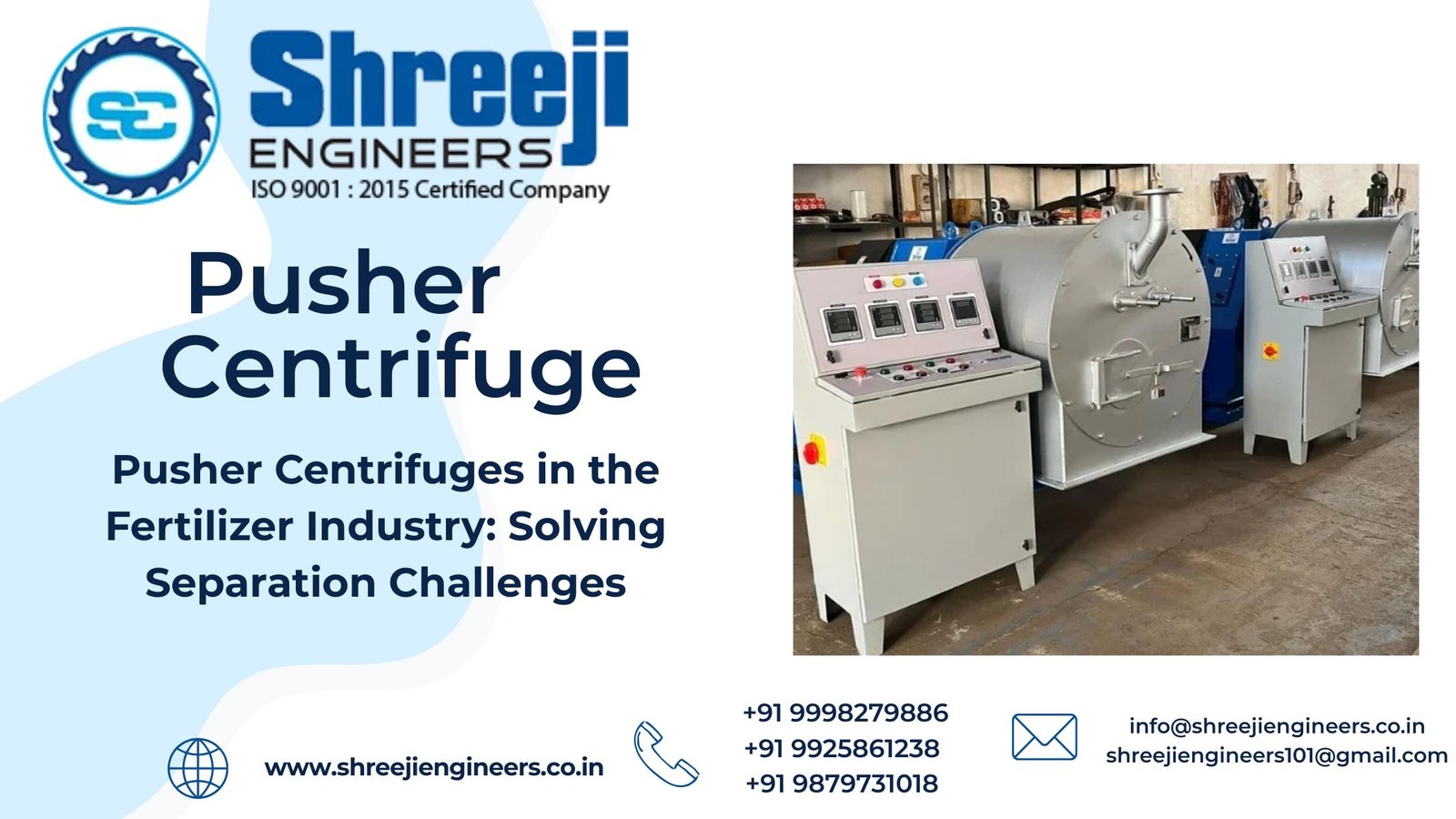
The Advantage: A Continuous Pusher Centrifuge eliminates these bottlenecks. By maintaining a constant flow of solids, you ensure that your downstream drying and bagging units remain fed, maximizing your plant’s total daily output.
3. Optimizing for Moisture and Purity
The quality of fertilizer depends on purity and low moisture content. Excess moisture can lead to “caking” in storage and transport, which is a significant quality issue for end-users.
-
The Advantage: Our pusher centrifuges are designed for optimized residence time, allowing the crystals to drain effectively. By managing the G-force and cake thickness within the basket, we help you achieve the low moisture levels necessary for a high-quality, free-flowing fertilizer product.
4. Why Reliability Matters
Fertilizer plants are often located in remote industrial zones. If a critical part fails, the cost of logistics and technical support can be high.
-
The Advantage: We focus on “simple but robust” engineering. Our designs minimize the number of complex parts, making the machine easier to maintain and troubleshoot on-site, even for teams working under tight production schedules.
Manufacturer’s Insight: When choosing a centrifuge for the fertilizer industry, prioritize the “Total Lifecycle Cost.” Look for a manufacturer that offers rapid access to Replacement Screen Segments—because when your plant is running 24/7, you need a partner who can supply parts as fast as you need them.
Export Countries
We proudly manufacture and export to customers across domestic and international markets. Our export markets include:
Turkey
- Bangladesh
- Philippines
- Thailand
- Sri Lanka
- Tanzania
- Uganda
- Indonesia
- Egypt
- Iran
- Ghana
We ensure secure packaging, timely delivery, and reliable export documentation for international customers.
Conclusion
Modern fertilizer production demands modern separation technology. If you are looking to increase your throughput, reduce crystal breakage, or lower your overall moisture content, it is time to evaluate the continuous performance of a modern Pusher Centrifuge.
Are you operating a fertilizer plant and looking to improve your separation stage?
Contact the engineering team at Shreeji Engineers today. We have the expertise to help you configure a machine that is built to handle the unique physical demands of fertilizer processing.

 Users Today : 10
 Users This Month : 189
 Total Users : 1097