Table of Contents
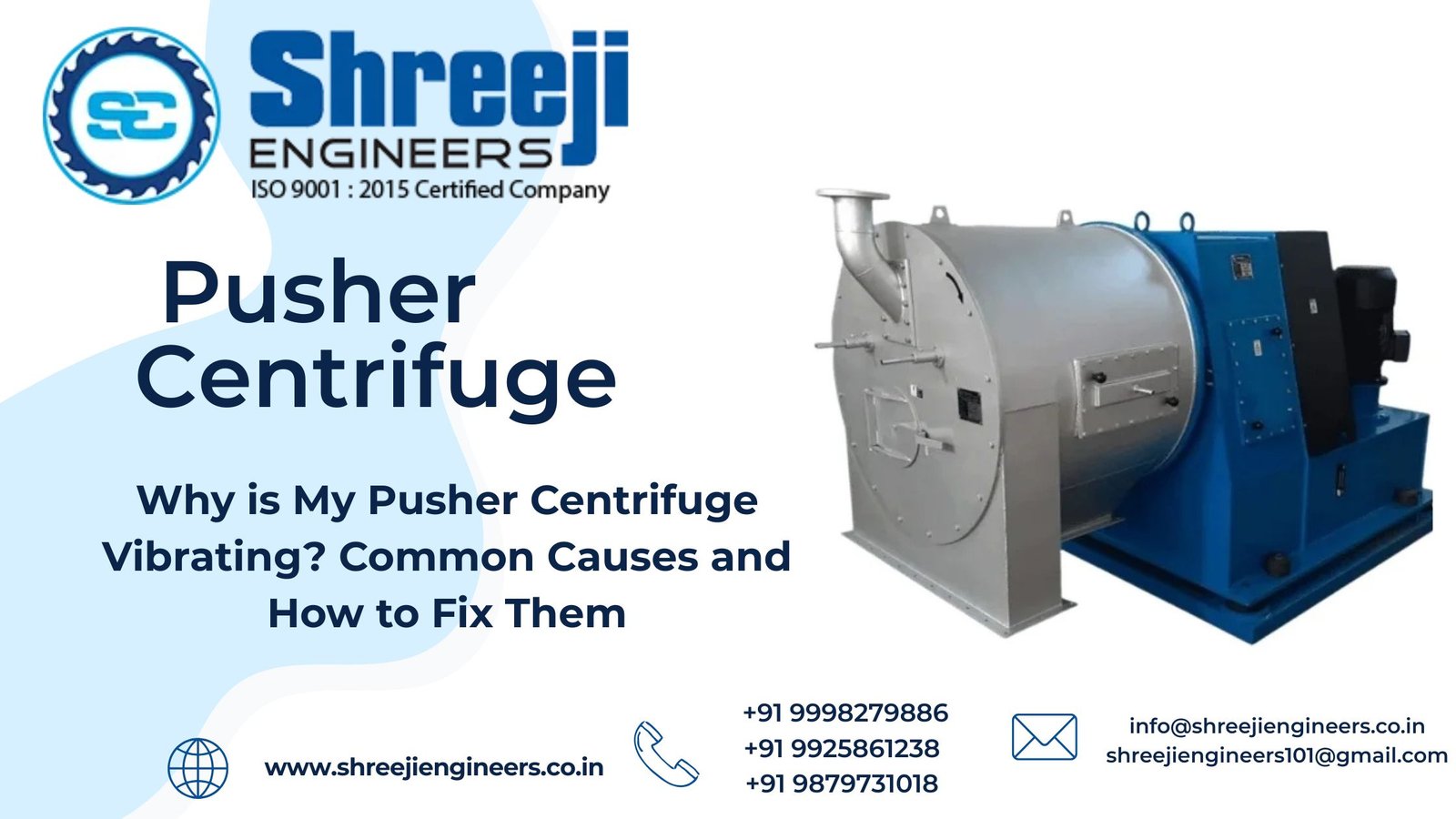
In industrial solid-liquid separation, your Pusher Centrifuge is the heart of your production line. When that heart begins to vibrate, it is more than just a noise problem—it is a critical symptom of mechanical stress that can lead to catastrophic failure if left unaddressed.
At Shreeji Engineers, we emphasize that vibration is the primary indicator that your machine is out of alignment, struggling under load, or suffering from component fatigue. In this guide, we will walk you through the five most common causes of vibration and the professional steps required to troubleshoot them.
1. Uneven Cake Distribution (The Feed Problem)
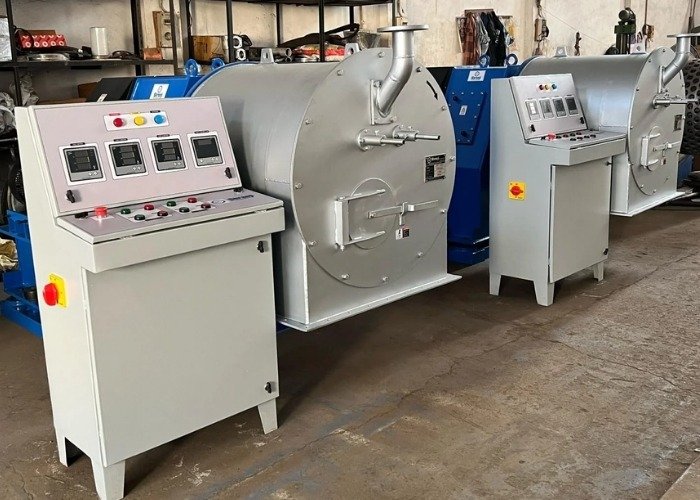
The most common cause of vibration is an unbalanced load within the basket. If the slurry feed is inconsistent, or the distribution cone is damaged, solids will not form a uniform cake around the basket wall. When the cake is thicker on one side than the other, the basket becomes dynamically unbalanced, creating a “hammering” effect as it spins at high RPM.
The Diagnostic: Observe the discharge cake. Is it coming out in pulses? Check the feed pipe for blockages or buildup.
The Fix: Inspect your feed pipe and distribution cone for mechanical wear. Ensure your feed flow rate is stable. If you are handling high-viscosity slurries, you may need to adjust your feed concentration to ensure it spreads evenly across the screen.
2. Worn or Damaged Filter Screens
The screen segment is the “filter” of your operation. If the screens are worn, torn, or improperly seated, solid particles can lodge behind the screen or clog the drainage channels. This causes uneven weight distribution. Furthermore, a loose screen segment can physically strike the housing, creating high-frequency vibration.
-
The Diagnostic: Look for “blinding” or uneven wear patterns on the screen segments.
-
The Fix: Perform a visual inspection of your Pusher Centrifuge Screen Segments. If you notice physical damage or sagging, replace them immediately. Always use precision-engineered, OEM-certified screens to ensure perfect weight distribution during rotation.
3. Bearing Failure and Lubrication Gaps
Industrial bearings are engineered for longevity, but they are not invincible. Over time, excessive heat, moisture ingress, or lack of proper lubrication can cause the inner races of the bearings to pit, spall, or wear down. A failing bearing often starts with a low-frequency hum and eventually progresses into severe, rattling vibration.
-
The Diagnostic: Use a temperature gun on the bearing housing. If the housing is significantly hotter than its usual operating temperature, the bearing is likely under extreme stress.
-
The Fix: Follow a strict lubrication schedule. If the vibration is accompanied by a grinding noise, stop the machine immediately and inspect the bearing assembly. Never reuse a bearing that shows signs of pitting.
4. Main Shaft Misalignment
The main shaft is the backbone of your centrifuge. Even a slight misalignment due to foundation settling, improper anchoring, or coupling wear can translate into violent vibrations as the RPM increases. If the shaft is not perfectly concentric, the entire basket assembly will oscillate, putting immense stress on the gearbox and the main motor.
-
The Diagnostic: Use a dial indicator to check the shaft’s run-out. Even a few microns of deviation can cause massive issues at operating speeds.
-
The Fix: Professional re-alignment is required. In many cases, you may need to check the vibration isolators or the machine’s mounting bolts to ensure the base frame hasn’t shifted over time.
5. Basket Imbalance (Dynamic Balancing)
If you have ruled out all the above factors, the issue likely lies within the basket itself. Over years of operation, the basket can lose its dynamic balance due to uneven erosion from abrasive slurries or accumulated solid buildup in hard-to-reach areas. An unbalanced basket acts like a centrifuge-sized “spin cycle” disaster.
-
The Diagnostic: Run the machine empty (without feed). If it still vibrates, the issue is mechanical/structural.
-
The Fix: This is a specialized task. The basket requires Dynamic Balancing, a process where technicians remove or add precision weights to the assembly to ensure it rotates perfectly on its axis.
Manufacturer’s Insight: Never ignore “minor” vibration in high-speed rotating equipment. What starts as a small tremor can quickly evolve into a broken main shaft, shattered screen, or structural damage to the housing. Preventive maintenance—specifically checking for bearing health and screen integrity—is significantly cheaper than a full machine overhaul.
Advanced Troubleshooting: The "Manufacturer’s Edge"
At Shreeji Engineers, we recommend that every plant manager maintains a vibration log. By tracking vibration levels weekly using a simple handheld vibration meter, you can catch trends before they become failures. If you see a gradual increase in vibration, it is a signal to plan for a service shut-down rather than waiting for an emergency breakdown.

 Users Today : 9
 Users This Month : 179
 Total Users : 1087