Table of Contents
In continuous industrial manufacturing, unexpected machine downtime is the costliest bottleneck a plant can experience. For heavy-duty equipment like a Horizontal Pusher Centrifuge or a high-capacity Hydraulic Pusher Centrifuge, smooth operation depends entirely on the micro-tolerances of its internal assemblies.
Because these systems continuously separate highly abrasive crystals—such as sodium chloride, ammonium sulfate, and fast-dewatering petrochemical solids—their high-speed internal components inevitably wear down over time.
For technical procurement managers and plant engineering heads, sourcing aftermarket Pusher Centrifuge Spare Parts that perfectly match or exceed original OEM standards is essential to protecting profit margins and maintaining operational integrity.
1. The Material Standard: Demanding SS316L, Duplex, or Super Duplex Steel
When ordering replacement separation media, structural metallurgy is your first line of defense against premature wear. Standard stainless steels fail rapidly under the dual stress of chemical corrosion and severe crystal abrasion.
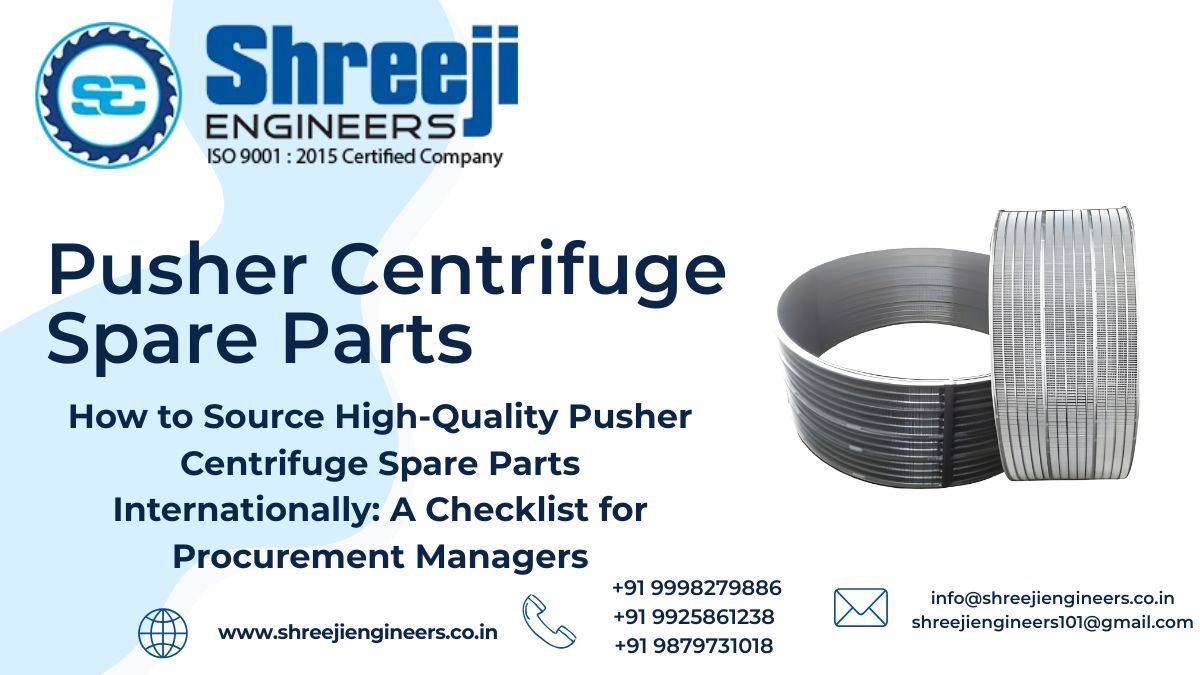
- Screen & Sieve Segment Components: The continuous filtration Screen and individual Sieve Segment panels must be fabricated from premium SS316L, Duplex Stainless Steel (e.g., 2205), or Super Duplex alloys. These materials resist localized pitting caused by chloride-heavy process fluids while providing the structural hardness needed to withstand continuous crystal friction.
- Slurry Contact Elements: Components that handle the initial high-velocity impact of wet slurry, such as the Distribution Cone and the central Control Piece, require uniform surface hardness to prevent severe pitting and premature erosion.
2. Dimensional Accuracy Across Critical Wear Zones
An industrial continuous centrifuge operates under intense centrifugal force, frequently exceeding 1,000 Gs. At these speeds, a dimensional variance of even 0.05 mm can lead to rapid mechanical failure.
The Filtration Assembly: Screens and Segments
The slot tolerances on your replacement Screen panels must be completely uniform. If a slot width is specified at 0.4 mm, any deviation allowing a 0.5 mm gap will cause immense product loss into your mother liquor stream. Conversely, narrow slots lead to blinding, reduced dewatering flow, and a dangerous spike in cake moisture content.
The Reciprocating Assembly: Pusher Rings and Discs
The Pusher Plate Ring and Pusher Disc are responsible for driving the dewatered cake layer forward along the basket walls. If the outer diameter of the pusher ring has too much clearance against the inner sieve face, fine crystals will slide backward into the gap. This traps abrasive solids underneath the mechanism, causing deep scoring along your expensive screens and putting massive back-pressure on the main hydraulic system.
The Alignment Elements: Shafts and Bushes
The smooth, perfectly linear movement of the internal piston relies on specialized friction-reducing sleeves. When sourcing these components, pay close attention to the precision tolerances of the:
-
Hollow Shaft
-
Control Bush & Front Bush
-
Rear Bush
If a replacement Front Bush or Control Bush is machined slightly out-of-round, it introduces micro-clearances. Over millions of stroke cycles, these minor clear spaces allow the main shaft to wobble slightly. This axial deflection quickly compromises your internal shaft seals, causing hydraulic fluid to leak directly into your dry processed crystals.
| Critical Component | Primary Technical Failure Mode | Sourcing Requirement / Quality Metric |
| Wedge Wire Screen | Slot widening, particle blinding, fine crystal bypass | Uniform resistance welding, V-profile wire accuracy |
| Pusher Plate Ring | Back-slip of solids, deep screen scoring, severe friction | Mirror-smooth edge finish, ultra-tight outer diameter tolerance |
| Control Bush / Bearings | Shaft deflection, seal degradation, oil-to-product leaks | High concentricity, precise internal diameter ground finishing |
| Distribution Cone | Uneven slurry loading, severe rotary balance issues | Flawless weight distribution, dynamically balanced structural hub |
3. The Hidden Cost Profile: Why Aftermarket Balancing Saves Assets
Sourcing heavy-duty parts isn’t just about matching part numbers; it’s about verifying physical balance. A new Pusher Plate Ring or Distribution Cone must be structurally balanced before it ever arrives at your maintenance facility.
If you install unbalanced elements into your rotating assembly, the resulting centrifugal variations will trigger severe structural vibrations. This vibration cascades through the machine, fatiguing the internal Wear Ring, breaking housing bolts, and eventually tearing apart your main bearing frames.
Always partner with an aftermarket manufacturer that possesses dedicated dynamic balancing rigs and provides certified test run verification for every rotating component shipped globally.
Securing Your Global Component Supply Chain
Whether you are running an Automatic Pusher Centrifuge in a high-throughput manufacturing zone or a cleanroom-compliant Pharmaceutical Pusher Centrifuge, component reliability determines your processing efficiency. Sourcing precision aftermarket components reduces maintenance budgets without risking unexpected processing halts.
Shreeji Engineers is an established manufacturer, global exporter, and engineering supplier of high-precision Pusher Centrifuge Spare Parts. From custom-slotted wedge wire screens and heavy-duty sieve segments to perfectly matched bushes, rings, and shafts, we design components to withstand the most demanding processing environments worldwide.

 Users Today : 0
 Users This Month : 191
 Total Users : 1099